KRISHNACORE

The spine of the archive

The complete history

How hardcore punk, straight edge and Krishna devotion collided in New York — and what that collision did to the people caught inside it. Told in seven movements, with the doubt and the damage left in.

Prologue

Before Krishnacore

Hardcore punk arrived as a negation. It rejected the music industry, the suburbs, the drugs, the future everyone was told to want — a wall of refusal with nothing required to stand behind it. For a certain kind of young person, that emptiness eventually became its own problem. Refusal is exhilarating and then it is exhausting, and the question of what to actually believe hangs in the air long after the last chord.

The first band to answer it plainly was Bad Brains. Four Black musicians from Washington, D.C. played hardcore faster and tighter than anyone, and they did it as Rastafarians — carrying explicit spiritual conviction into a scene that prided itself on having none. They proved a hardcore band could believe in something out loud and lose no intensity for it.

In New York, the current ran toward a different faith. John Joseph — a former Bad Brains roadie — encountered Krishna consciousness and, after leaving a tour, lived in a Hare Krishna temple in Hawaii before returning to the city. When he took the microphone in the Cro-Mags, he brought that devotion with him. The band's 1986 debut, The Age of Quarrel, took its title from the Bhagavad Gita's Kali Yuga, the age of discord and collapse.
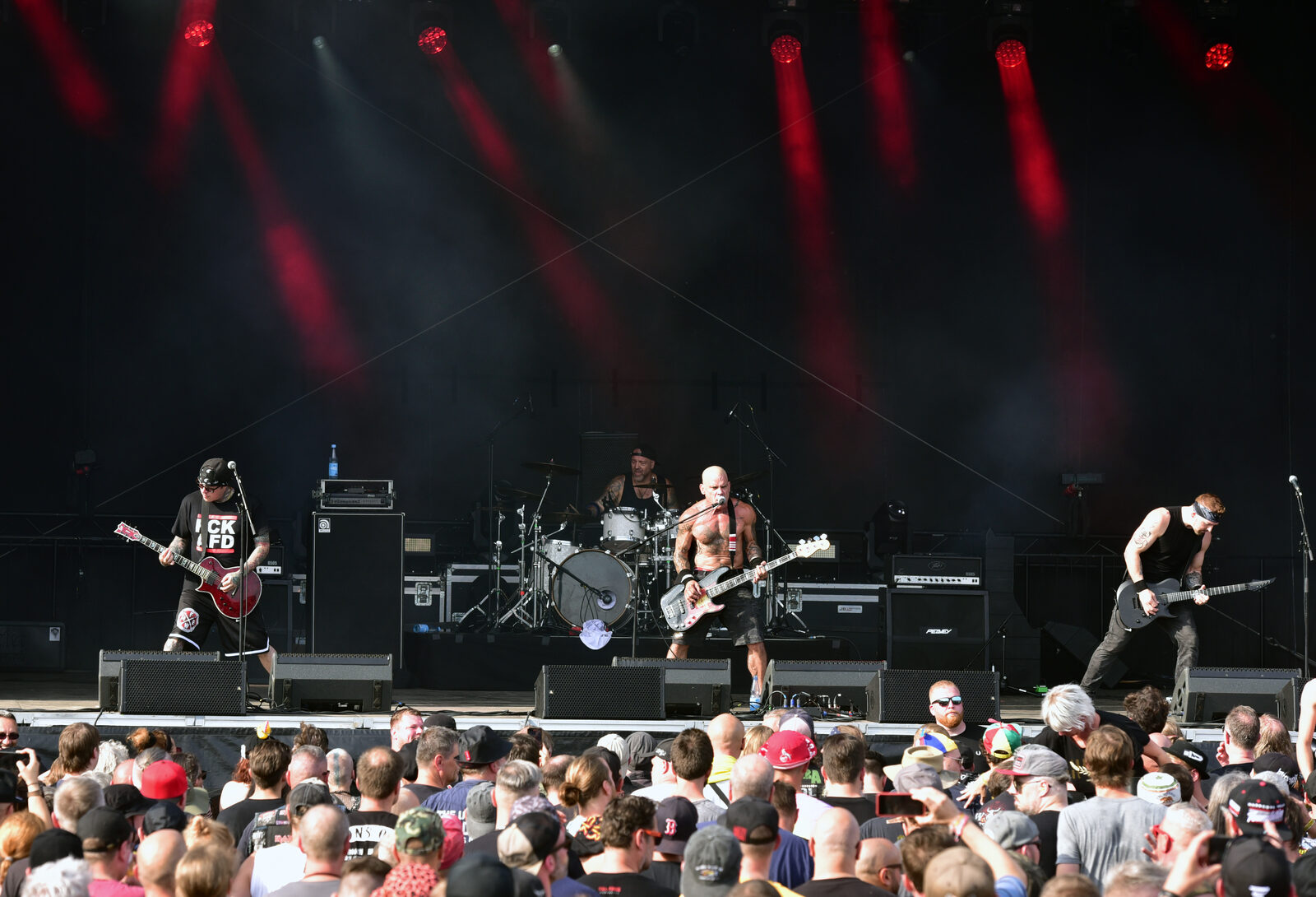
The Cro-Mags performing live, 2024
The Cro-Mags live, 2024 (the present-day Harley Flanagan lineup). Photo: Frank Schwichtenberg, CC BY-SA 4.0, via Wikimedia Commons (share-alike applies).

The New York scene was chanting about the end of the world in Sanskrit before anyone thought to call it a genre.

Alongside the Cro-Mags a parallel discipline was forming. Straight edge, born of Minor Threat's refusal of drink and drugs, had hardened in New York into the "Youth Crew": a clean-living, often vegetarian code with its own uniform and its own evangelism. Its loudest voice belonged to Youth of Today, formed in 1985 by vocalist Ray Cappo and guitarist John Porcelly. Records like Break Down the Walls (1986) turned abstinence into a positive creed — a body kept deliberately, a life kept sharp.
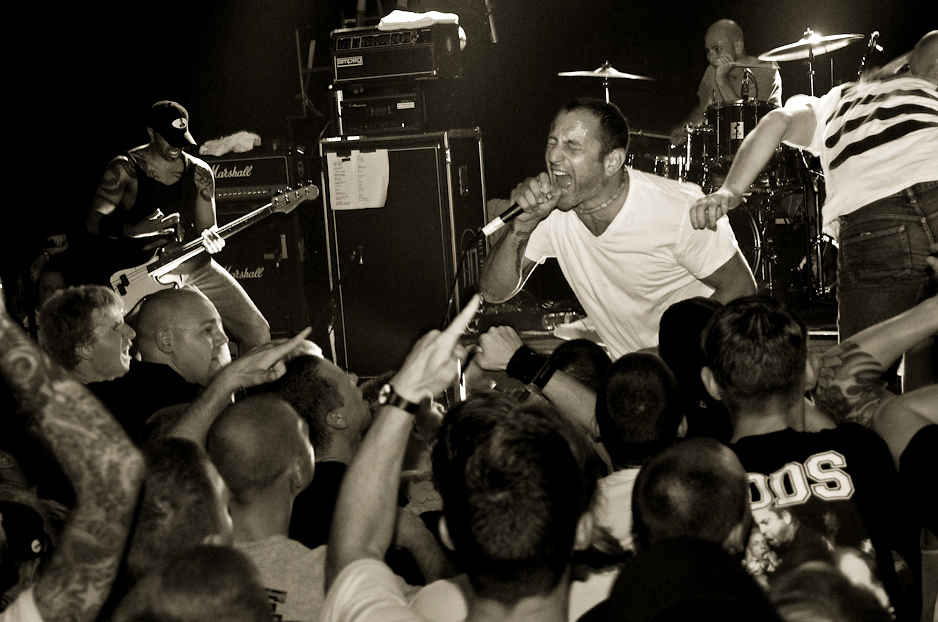
Youth of Today performing live at SO36, Berlin, 2010
Youth of Today, SO36 Berlin, 2010. Photo: Libertinus Yomango, CC BY-SA 2.0, via Wikimedia Commons (share-alike applies).

Straight edge was, though few said so at the time, already a spiritual practice waiting for a theology. It disciplined the body and asked for devotion; it just had no god to point that devotion at. As Youth of Today wound down, Cappo went looking for one. The Gita answered on all counts. The wall of refusal was about to acquire a deity.

Part I

1991 — The eruption

Ray Cappo left Youth of Today, traveled to India, and came back a Hare Krishna devotee. What had been a lyrical accent in the Cro-Mags became, in his new band, the entire point. Shelter formed with Cappo and, for a time, his Youth of Today bandmate John Porcelly — hardcore built expressly to carry Krishna consciousness to the pit. Devotion was no longer subtext. It was the mission statement.

The same year produced Shelter's mirror image. Vic DiCara, who had played in the de la Rocha-fronted Inside Out and briefly in Shelter itself, co-founded 108 with vocalist Rob Fish. Where Shelter reached outward, 108 turned the devotion inward and let it burn.

Around both bands grew an institution. Cappo started Equal Vision Records with Steve Reddy to release Shelter's music; for several years it functioned as an essentially all-Krishna label. A kid could hear a record, write to a label, show up at a show, and end up at a temple — the pipeline ran in both directions. Critics reached for a label, and "Krishnacore" stuck.

June 1990 · The backlash

The night the flyers came out

It almost didn't get a warm welcome. In June 1990 — before Shelter had a record anyone had heard — the band played its very first show at the Anthrax club in Norwalk, Connecticut, on a bill with Inside Out. Youth of Today were still gods at the Anthrax, so the room was packed. Out in the parking lot, a crew of ABC No Rio regulars were waiting with homemade flyers denouncing the arrival of a religious movement into hardcore. One read simply FUCK RELIGION. Another set a Hare Krishna symbol beside a swastika.

The confrontation ran for hours, face to face, flyer by flyer. Then Inside Out took the stage, and their young singer — Zack de la Rocha, years before Rage Against the Machine — held up the swastika flyer. He said he didn't know what he thought about the Hare Krishnas, but that equating them with Nazis was, in his words, just ignorant — tore the flyer in half, and the band detonated into “No Spiritual Surrender.” As Vic DiCara later put it, the bands were simply too good that night; the mosh won more converts than any slogan could.

Two passionate crowds, one Connecticut parking lot, and a scene deciding out loud what it was allowed to believe.

Decades on, the people on both sides remember it as one of the most sincere nights hardcore ever produced — everyone in that lot, believers and protesters alike, completely meant it. It was the whole punk ethos turned on the scene itself: question everything, including your own idols.

Oral history: Freddy Alva, “The Anti-Krishna Flyers Incident of 1990,” No Echo — with Vic DiCara, John Porcelly, Norman Brannon, Adam Nathanson, Melissa York, Chris Strickland, Charles Maggio, and Dave Koenig.

Part II

The two poles

The genre is best understood as a tension between its two flagship bands, because they wanted opposite things from the same faith.

Shelter was the accessible, optimistic, missionary face. Cappo's charisma was inclusive; the music grew steadily more melodic across Attaining the Supreme (1993), Mantra (1995) and beyond, and the message was an offer: here is a way to live with meaning, come and take it.

108 was the confrontation. DiCara and Fish made devotion sound like a fight with oneself — self-conflict, rage, and an intensity that could tip into instability. Years later DiCara would point out that 108 was in many ways rebellious toward ISKCON, and that the Krishna consciousness a listener absorbed from the band bore little resemblance to what they would meet at a temple.

One band handed you an invitation. The other handed you a mirror.

That polarity is the heart of the story. Krishnacore was never a single message. It was an argument between optimism and unrest, held together — barely — by a shared deity and a shared scene.

Part III

The expansion

For a few years the circuit widened fast. A second tier of bands formed around the two poles — projects like Prema, Refuse to Fall, Baby Gopal and Worlds Collide among them — each working some part of the devotional-hardcore spectrum. 108 pressed on with Songs of Separation and Threefold Misery (1996); Shelter signed to Roadrunner and pushed toward a broader rock audience.

It also went international. Krishnacore took root in Europe and South America, where local temples, distributors and zines built scenes that were never simply imitations of New York. The music's reach outran its birthplace, which is exactly when a movement stops belonging to its founders. See the full records archive.

The connective tissue was unglamorous and essential: photocopied zines, mail-order distros, hand-drawn flyers, temple newsletters, cassette dubs. This is the material the archive most needs to preserve, because it is the material most likely to be thrown away.

Part IV

The fracture

The same white-hot intensity that made Krishnacore matter is what eventually cracked it. A scene built on punk autonomy had bolted itself to a tradition that asked for surrender, obedience, and celibacy — and those are hard vows to keep at twenty-two, on tour, in a genre that runs on rebellion.

The contradictions surfaced one by one. The straight-edge promise of total self-control met the temple's promise of total submission, and the two did not always sit easily. For some, Krishna consciousness was the most freeing thing that ever happened to them; for others it started to feel like they'd traded one uniform for another.

Rebellion had found a religion — and then, being rebellion, it started to question that too.

The musicians felt the ground shift, and they didn't hide it. Vic DiCara spent the better part of a decade as a monk in India and eventually walked away from ISKCON entirely, saying plainly that he'd stopped believing. When 108 reformed, he and Rob Fish were on the far side of the faith that once defined them; in 2010 Fish left the reunited band rather than fake it. The people who had once made devotion the entire point were now, out loud, revising the story — which was, in the end, the most punk thing they ever did.

Part V

The afterlife

Krishnacore did not so much end as disperse. Shelter and 108 both returned in later years, playing to audiences that now included people who had grown up on the records and people encountering them cold. Younger bands rediscovered the sound, sometimes for the spirituality and sometimes purely for the ferocity.

What proved most durable was often the discipline rather than the deity. Veganism and straight edge outlived the religious wave, carried on by people for whom the ethics survived the theology. For some, the devotion remains entirely real. For others, Krishnacore became aesthetic nostalgia.

The founders scattered into ordinary complexity. Vic DiCara lives in Japan and works as a Vedic astrologer and translator of Sanskrit texts. Ray Cappo continued in music and in a spiritual life on his own terms, and has since written a memoir, From Punk to Monk. The tidy arc — lost kids find God, God saves them, the end — is not what the record shows. What it shows is people who believed intensely, changed their minds in public, and are still, decades on, revising the story.

So: alive, dead, or transformed? All three, depending on whom you ask.

Keep exploring

Go deeper

Follow any thread from here — the two bands that defined the sound, the people who made them, the movement they joined, or the full chronology.

Sources